Research Highlights
NIH Grant Awarded to Fernandez-Valdivia Lab for Breakthrough Lung Cancer Detection Assay
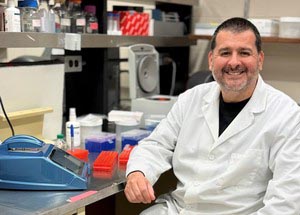
Rodrigo Fernandez-Valdivia
Ph.D., MAS
Head of Departmental Shared Resources
Associate Professor, Department of Pathology

Ann Schwartz, Ph.D.
Deputy Center Director,
Karmanos Cancer Institute
Associate Chair & Professor, Department of Oncology

Randy Armant, Ph.D.
Chief Scientific Officer, AleloPharma Inc.
The Fernandez-Valdivia laboratory has recently received an NIH R43 SBIR Research and Innovation grant to develop an ultra-precise and ultra-sensitive method to detect the tumor-specific Echinoderm Microtubule-Associated Protein-Like 4 (EML4)-Anaplastic lymphoma kinase (ALK) DNA rearrangement events in liquid biopsy specimens (such as plasma) of non-small cell lung cancer (NSCLC) patients.
The EML4-ALK rearrangements represent a key driver of NSCLC in some specific populations, particularly younger, non-smoking, or light-smoking individuals. Tumors that carry the EML4-ALK rearrangement mutations may be treated with targeted therapies, such as alectinib, and experience durable and long-term responses.
However, clinical screening and stratifying patients for the targeted therapies remains an unmet challenge since the overall incident rates of EML4-ALK rearrangements are low (4–5%), and the current tests do not have sufficient sensitivity and precision.
The design of this new assay is stemmed from the novel technology developed in Dr. Fernandez-Valdivia’s laboratory for the detection of the severe acute respiratory syndrome coronavirus 2 (SARS-CoV-2) and sensitive diagnosis of early coronavirus disease 2019 (Covid-19) infection, which is widely recognized and received multiple awards including its selection as one of the best technological innovations worldwide in the Covid-19 Sprint, the TechConnect’s Innovation Award, and the TDI-ADVANCE Award by the Michigan Economic Developing Corporation (MEDC).
The research group expects that the new assay can detect a single target molecule per reaction while eliminating false positive results by a novel algorithmic process. If successful, this assay will be a valuable non-invasive tool for early diagnosis and recurrence surveillance of EML4-ALK positive patients.
The clinical application of this new assay may help to shift the patient care schemes from reactive to preventative or protective.